

Choosing the Optimal Cooling: Liquid vs. Air
The rising demand for AI and cloud services has outpaced traditional cooling methods in high-density environments. According to the Data Center Trends 2025 report by Vertiv, rack densities are expected to soar to 500-1000kW in AI-driven facilities, necessitating superior cooling strategies to prevent costly downtimes due to overheating.
Traditionally, air cooling has served data centers well, yet its effectiveness diminishes with increasing rack densities. For facilities experiencing such growth, liquid cooling emerges as a superior solution, ensuring optimal temperatures for high-density equipment.
Understanding Liquid and Air Cooling Techniques
Efficient data center operation hinges on robust cooling systems. Both air and liquid cooling strategies eliminate excess heat, but they employ distinct methodologies. Air cooling uses air circulation to displace heat, ideal for less dense environments with systems like the Liebert PDX Compact DX Cooling System or Liebert ® CW Chilled Water-cooling System.
Conversely, liquid cooling circulates water or specialized fluids to absorb and dissipate heat more effectively, suiting high-density applications. This method includes:
- Direct-to-chip cooling: Directly targets server chips, examples include the Vertiv™ CoolChip CDU.
- Rear door heat exchangers: Mounted on server racks to manage expelled heat, such as the Liebert® DCD Water-Cooled Passive Rack Door.
- Immersion cooling: Envelops entire servers in a cooling liquid.
These methods are more direct, accommodating higher heat loads than air cooling.
Determining the Best Cooling Strategy for Your Needs
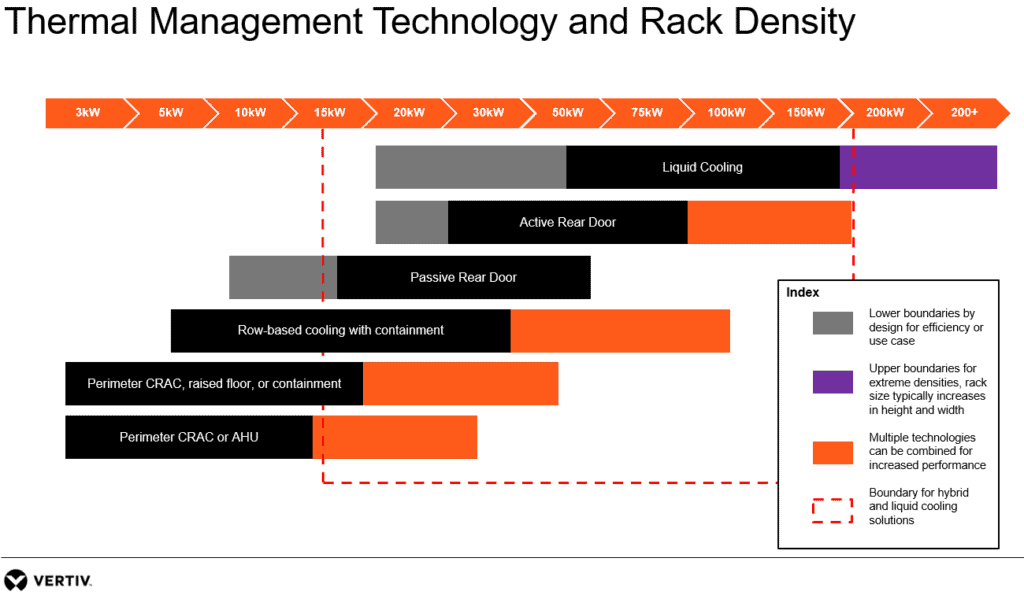
Choosing the right cooling system hinges on the density of your racks. For low-density racks using less than 20kW, air cooling solutions are adequate, such as Liebert DS Direct Expansion Cooling System, which utilizes air to maintain optimal temperatures.
High-density racks, exceeding 20kW, benefit from liquid cooling, particularly as they approach 30kW or more. When air cooling systems struggle, employing a hybrid approach that combines air and liquid cooling can enhance efficiency and reduce energy usage. For instance, the Vertiv™ CoolChip CDU, designed for hybrid cooling, delivers liquid to server chips while managing room temperature through air conditioning.
Explore Advanced Cooling Solutions with Us
Maintaining the right environment for your data center involves more than just cooling. Organization, security, and keeping up with technological advancements are crucial. Stay informed about the latest in cooling technology by joining our newsletter. For expert guidance tailored to your facility’s unique needs, contact Faulkner Haynes & Associates at 919.781.8840.
FAQs about Liquid Cooling
- What is liquid cooling? Liquid cooling uses fluids to absorb and dissipate heat directly from server components.
- When should I consider liquid cooling? If your facility has racks exceeding 20kW, liquid cooling is advisable to efficiently manage heat.
- What are the benefits of a hybrid cooling approach? Combining air and liquid cooling can reduce energy usage and manage high heat loads effectively.
- How does immersion cooling work? Servers are submerged in a nonconductive liquid that absorbs generated heat.
- Is air cooling suitable for all data centers? While air cooling is effective for lower densities, high-density racks often require more advanced cooling methods.